|
 |
It's common knowledge that the first time, by hook or by crook, you'll never forget it. This is true even if you have to make an interview. My first interview, the first for designunits . It's also common knowledge that if something may go wrong it will, like it happend to me. Even though I've bought two spare boxes of batteries and tapes, my cassette recorder betrayed me, which is not a good thing when you planned to interview six people at the same time. Anyhow, with the help of a Bic and with the utmost synthesis I made it. However what you are going to read is far more like a reportage of a chat than the writing out of an interview.
Rome 07/04/04
It's lunch time and I find myself in front of number 47 of Via Fabiola in Rome with a bottle of fine Merlot in my hand and a lot of curiosity in my head. Here is the 21 st Century Design's studio. There is only one door-bell, you can't go wrong, even tough you are a bit puzzled because you're stepping on a driveway. Actually, designers are often known for the eccentric places where they decide to have their studio, which sometimes reflects their personality. In this case, as I did understand later, the place has no value without the people that are able to make it highly creative and active with the crossing of their life and the mixing of their experiences.
As I enter the studio, Tommaso, which is at the phone, greets me with a nod and waves his hand to make me know that he'll soon come to me, just like the others that are out for shopping. So, while waiting, I take the occasion to free my curiosity and I start looking me around. The studio at once seems very comfortable and strangely familiar, maybe because it looks like my bedroom , full of books, cds and… “stuff”.
While I'm looking at their comic collection from a door enters Emanuele, Tommaso's brother, who together with Giovanni have a studio called “Mekkanografici Associati” communicating with the 21 st Century Design's studio trough a short corridor.
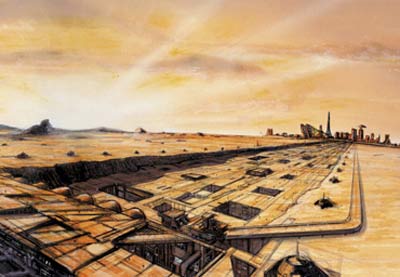
I must say that I liked so much this “joining”, which at once may seem so valueless. At that moment, in my head started to appear some sort of surrealistic and utopian visions of small brain-cities where the places of knowledge and creation are physically linked one to the other trough dynamic corridors and where knowledge sharing is the only true society's engine. Everyone should have a door trough which get in our friend's room, to search their bookcase for that book we were interested or for the one they stoled from ours a year ago. Maybe doing it while whistling the Star Wars theme like Emanuele and Tommaso were doing.
While we were joking with the Star Wars themes, the others arrive with the shopping bag.
The studio was opened by Tommaso Ragnisco, Cristina Croce and Alessandro Spalletta in 1995, after they graduated from the I.S.I.A (Istituto Superiore per le Industria Artistiche) of Rome .In 2002, Marco Flore and Maurizio De Vincentiis also from the ISIA and Gaia Morelli from the Central Saint Martins College of Art and Design in London joined the team. Unfortunately today everybody is at the studio except for Cristina, what a pity a would've know her too.
We introduce ourselves and we start to lay the table for lunch.
There is no such place like Italy, where else would happen to you to interview someone while eating a Rosetta (a typical Roman shape of bread) stuffed with ham and mozzarella and sipping a fine red wine?
The atmosphere I breath is very pleasant, we joked, we laughed and we passed ham's slices to each other. I'm starting to make the “intelligent” questions I prepared , when I realize that my trusty cassette recorder has decided to betray me just when I needed his duties more than ever. [I think I'll write sooner or later something about it.]
Panic!
When I was at school I wasn't so good at making notes, I preferred to listen, at least not so good as some classmates I had, who had the shape and the printing speed of a laserjet. Anyway, even if I wished to be in that precise moment a little bit like my Epson printer, with a Bic and the question's paper at hand, I started the interview.
I ask them why they decided to open their studio in Rome while everybody seems to consider Milan as the Italian capital of design.
As they'll do during the whole interview, the guys sincerely reply that, it was the most natural thing to do to whom was born and growth in Rome . The most important thing is to live and work in an environment made of interesting people and stimulating places. This city, they add, is full of art, the weather is fine and it's full of fantastic people, both in a creative and human point of view. This makes it a good choice between Milan and other Italian cities. “We had the luck to be born in Rome , while they had the bad luck to be born in Milan .”
Unlike many people may think they say there's a lot of work here for a designer, and this is something I also believe. Moreover, they told me that they also decided to open the studio because they didn't won't to end up working for some famous designer in his huge studio or have their ideas stolen by some firm which prefers to have it signed by that same famous designer.
After a bite of my tasty Rosetta, I go on with the second question which wants to investigate more the relationship between Rome and design.
On the first days of November (2003), at the Casa dell'Architettura in Rome took place the First National Meeting on Design (Primo Incontro Nazionale con il Design). The meeting was focused on the role of design in the country's growing strategies. In the same month, at the Ministry of Foreign Affairs was presented to the press the fourth edition of the ADI's Design Index and the project to make an international observatory of design here in Rome .
This events made many Roman designers believe that finally their city was opening to the design world. So I ask them what they think about it and if they can see any changes since their studio opening.
Substantially, they say, nothing changed. They are concerned with the importance that these events have when it comes to make those useful tools to protect designers and their work, which's in no way clearly defined and known in commercial terms and tightly linked to the arguments on intellectual property. However the point remains, for them, to have cultural exchange and do, do, do…
In this way, all this kind of initiatives are welcome if they open new spaces where designers, but not only, can show their creativity and know the other's. Especially if supported by the knowledge of some firms, which are sensible to the development of resources not known in Italy . This firms must also be able to offer practical impulses to young (but not only) designers for their professional growth. This topic tickles my interest so I decide to get a deeper knowledge of it. On their web site ( www.21lab.net ) they talk about a “philosophy of participation and discussion over designs” and “crossover between talents and disciplines”, this makes me think that contamination is a basic element for their creativity , so I ask them if there're any other secret ingredients in their magic potion. Actually, they say, the exchanging of ideas and opinions is the basic element of their creativity and there ain't no other secret ingredients than hard work. You never have to stop, they add, got to do everything to reach goals and realize projects. To do this it's important to find the right people, who have know-how and wish to work hard, but most of all with whom you get well together. Being a team helps to be active in many market's fields. It push us in areas not typical for design. This is necessary for the pure pleasure of keeping your creativity in exercise with new challenges and for the economical survival that, otherwise would be depressed by the limited industrial field of products. In this way everyday the designer's job is redefined in its market's function and in itself.
From their answer, I spontaneously ask if I can define them as a team of people that wants to have fun while working. It's absolutely correct, they tell me. Society grows better only if people is productive and people is productive only if it's spurred correctly with intelligence and with that Italian's artisan humility that drives the world crazy. To do this it's important to be friends an share the same vision. In our work, they add, it's important to see everything with child eyes, but grown. Always like the “first time”.
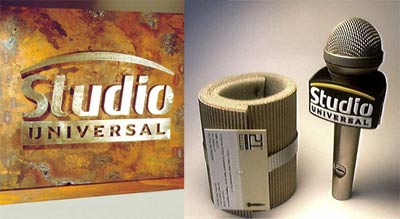
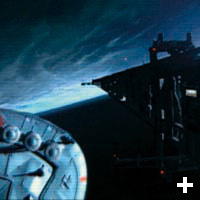
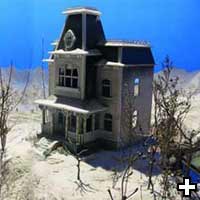
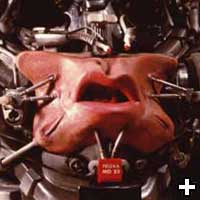
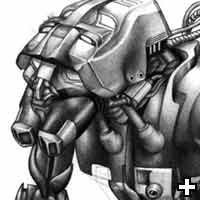
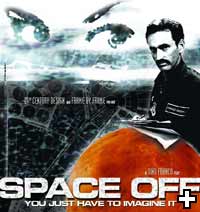
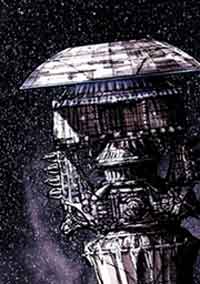
After another bite and after listening to what they told me, I ask how was conceived the choice of focusing on film design, realizing the multi-prizewinner short Space Off ( www.spaceoff.it ). It's been their great passion for cinema, they confess, that brought them to film design, a field that perfectly marry their ability acquired during studies. This is the same area in which they want to become experts as an agency. You have to think cinema, they continue, as a real industry, and the movie as an industrial product. From this point of view it's easy to understand that we are fully qualified to work in this field, which exalts designer's creativity. You've got to work with different stuff and technology and you can even learn a lot. I agree, the link between design and cinema, especially in science fiction, is biunique. Usually designers are inspired by cinema, as many directors take inspiration from design to create their movies. Think about 2001: A Space Odyssey , in which Kubrick wanted the Olivier Mourgue's “Djinn” armchair because he though it would perfectly fit the living room of his “Hilton Space Station”. There can be a lot more examples. But when we talk about special effects and setting, in comes in my mind that the verb “to design” also means “to simulate”, and where else, if not in a movie (or in a show), we simulate reality even if it's different from the one we know?
I finish my Rosetta and my questions, so after a sip of wine I ask if the presence of Cinecittà (the most famous film studio in Italy ) is relevant in choosing film design as a career. Not at all, they confess. However, the presence of a team of valuable people that work for Cinecittà is surely a positive aspect, but not always. The guys tell me about some haunting tales of scarce professionalism with some “film's experts”, and I remain astonished. But now it's clear: they confide mostly in their abilities and in a group of few reliable friends, such as Tino Franco the director of the short Space Off.
We are having a cup of coffee, the interview is quite at the end, and I go on with the last questions, so I ask what are they working at now. They tell me they are working on a serial (a science fiction?), some jewels, but most of all on educational machines for museums, the world of exhibit design is the one that pays for the moment. Maybe, they confess, we don't make “traditional” industrial design, because developing industrial products requests years for testings and market's inlet.
Unfortunately we are at the end of this hour passed in pleasant company. With the bitter taste of coffee I ask if there is someone that mostly influenced their work. There are a lot of people that inspires them, who are, for example, Leonardo da Vinci, Stanley Kubrick, Chris Cunningham and Nick Park. H.G. Giger (giger.com), Carlo Rambaldi and Aardman Animations (Wallace & Gromit), John Lasseter (founder of Pixar) and Art Leonardi (animator of the Pink Panther, and man with an osmotic personality). Den O'Bannon, John Carpenter, George Lucas, and Otomo Miyazaki. Jean Giraud (alias Moebius), Juan Gimenez, Oscar Chiconi, Magnus and Andrea Pazienza. The philosopher Howard Zinn and Alessandro Chelo (we suggest to read his “La leadership secondo Peter Pan” edit by Sperling & Kupfer), Syd Mead ( www.sydmead.com ), Studio Azzurro, Arnaldo Pomodoro, Enzo Colani and Droog Design. Rock and Jazz, live music and concerts, from Beatles, to U2, Ween and King Crimson. Sure the list is longer and these are only the first that came into their mind...on the other hand, a designer for them must be open minded!
The interview is over, I just talk a little more with them that silently have started working again. Someone is at the PC to cut a video or to give the finishing touches to a spaceship, an other one is working with the Dremel to mill a model, but the overall view is of a studio of young designers that really get on very well together.
|
 |















.jpg)